Heatless Curls for Short Hair: 5 Methods That Actually Work

Every heatless curl tutorial seems to be filmed on waist-length hair. On short hair the standard advice fails in predictable ways: the ribbon slides out because there’s nothing weighing it down, sock curls unravel at the nape, and the back pieces — too short to wrap — stick out straight while the front curls beautifully.
Short hair can absolutely do heatless curls. It just needs adapted methods: smaller sections, anchors placed higher, and tools sized for less length. Our main heatless overnight curls guide covers the three classic methods for medium and long hair; this guide is the short-hair version, for bobs, lobs, long pixies, and everything in between.
Why Short Hair Needs Different Methods
Three things change when length disappears:
- Less weight, less hold. Long hair’s own weight keeps wraps in place overnight. Short wraps need mechanical help — clips, crossed pins, or a headband over the top.
- Shorter setting time. Less hair dries and sets faster. Most short-hair methods need 4–6 hours, not a full night — you can set your hair after dinner and sleep in a looser style, or set it in the morning for an evening event.
- The nape is the problem zone. The shortest hairs live at the back hairline and escape every wrap. Every method below includes a specific fix for them.
Before You Start: Dampness and Sections
Use hair that is about 80% dry — damp to the touch, never wet. Short hair holds proportionally more water near the scalp, and wet-wrapped short hair is still damp at the roots by morning, which means the curl collapses within the hour. A light leave-in or a small amount of mousse through the lengths gives the set something to hold onto. Whatever method you choose, work in more, smaller sections than you think you need: on short hair, section size is the difference between waves and a single kink.
Method 1: The Ribbon or Headband, Placed Higher
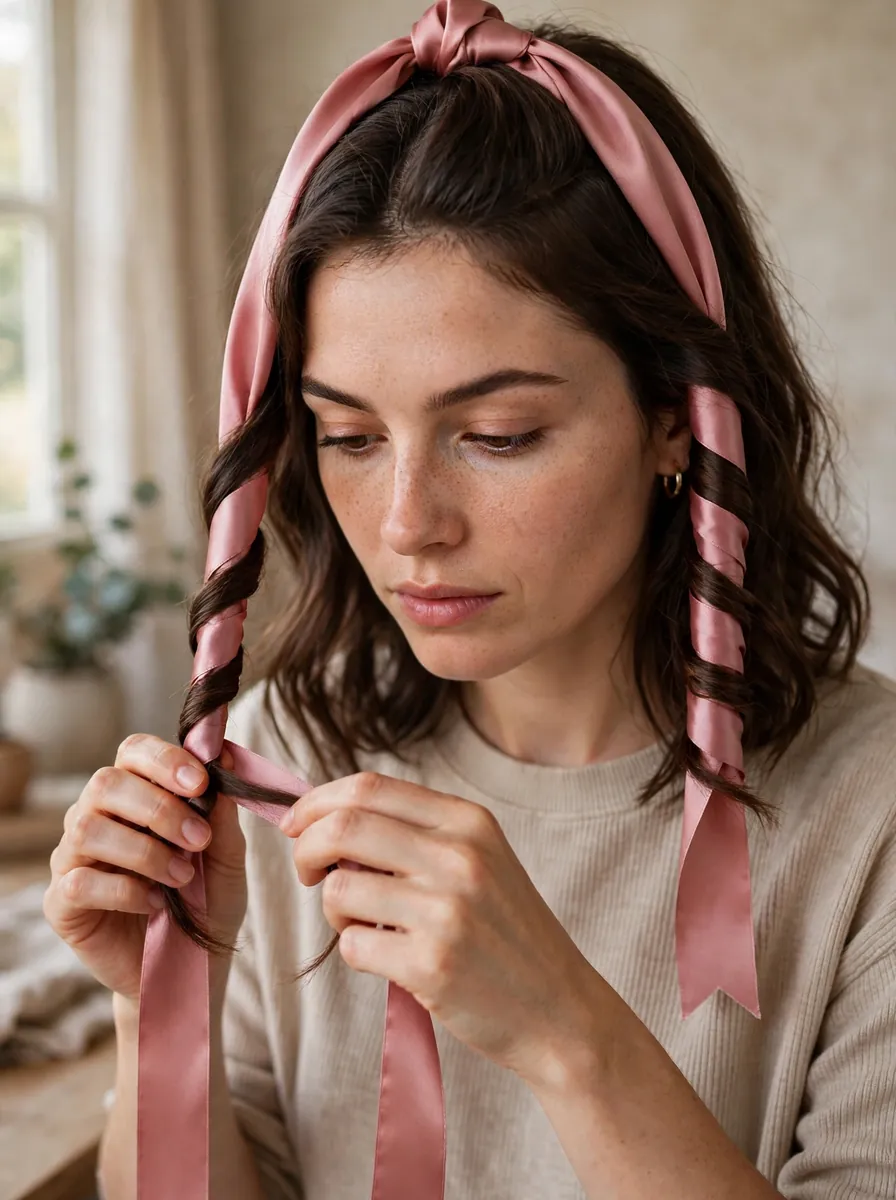
The satin ribbon (or a soft curling headband) still works on bob-length hair and above — with two changes. Place it higher and further forward than the long-hair version, closer to the hairline, so the short front and side pieces are long enough to complete at least one full wrap. And clip the ribbon at the top of the head with a claw clip: on short hair the ribbon migrates backward overnight without an anchor.
Wrap in smaller pieces than feels natural, winding each section fully before adding the next. At the nape, the last centimetres usually won’t reach the ribbon — leave them; they’ll be handled by Method 4 or a two-minute morning fix (below).
Best for: bobs and lobs, chin length and longer. Result: loose blowout-style waves. Time: 5–6 hours or overnight.
Method 2: Two Mini Sock Curls
One sock curler asks too much of short hair. Two smaller ones — one each side, or one top and one back — divide the hair into zones short lengths can actually complete. Use thin socks or stockings rather than thick gym socks, roll smaller donuts, and take vertical sections no wider than two fingers.
Roll each section under, toward the head, and secure the sock ends together with a soft scrunchie rather than tying the sock itself, which creates a dent. Sleep comfort is better than the single-sock version because nothing sits at the very back of the head.
Best for: chin-length bobs to pixie-bob length. Result: soft, round curls with volume. Time: 4–6 hours.
Method 3: Flexi Rods
Flexi rods are the most reliable heatless tool for genuinely short hair, because each rod is its own anchor — nothing depends on length or weight. Choose the thinnest rods (7–10 mm) for pixie-to-bob lengths; thicker rods on short hair produce one bend rather than a curl.
Wrap small sections around the rod, roll toward the scalp, and bend the ends to lock. Direction matters more than precision: alternate directions row by row for a natural result, or roll everything away from the face for a styled, retro finish. Rods are also the only method here that works well on the nape — the shortest pieces can still complete a turn around a thin rod.
Best for: pixie length and up; anyone whose wraps keep escaping. Result: defined curls, tightness set by rod size. Time: 4 hours minimum; overnight for maximum hold.
Method 4: Pin Curls for the Shortest Hair
The pre-1950s method is still the best one for very short hair. Take a small section, curl it around two fingers into a flat coil against the head, and pin it with two bobby pins crossed in an X. Pin curls need almost no length — a section 7–8 cm long is enough — so they cover pixies, the nape of bobs, and every piece the other methods miss.
Set them in the direction you want the wave to fall, let them dry fully, and unpin in reverse order. Brush through gently with your fingers, not a brush, unless you want a full vintage wave — in which case brush thoroughly and the separate coils merge into one sculpted pattern.
Best for: pixie length, nape and fringe rescue, vintage waves. Result: defined waves and curls, very durable. Time: 3–5 hours.
Method 5: The Robe Belt, Short Version
The robe-belt method from social media works on short hair if you treat it as two separate wraps rather than one continuous one. Drape the belt as usual, but wrap each side’s sections only until they run out — then pin the wrapped bundle to the head with a large clip instead of continuing to wind imaginary hair. The pinning is not optional at this length; an unpinned robe wrap on a bob is on the pillow by 2 a.m.
Best for: lobs and longer bobs. Result: loose, face-framing waves. Time: 5–6 hours or overnight.
The Morning Routine (and the Two-Minute Nape Fix)
Unwrap everything slowly, in reverse order, without pulling. Separate the curls with fingers only, tilt your head upside down, and shake at the roots — short hair gets its volume from the roots, not the lengths. A tiny amount of oil on the palms, pressed (not dragged) over the surface, settles frizz while keeping the set.
For straight nape pieces that escaped: mist them lightly, twist each around a finger into a coil, pin for two minutes while you do makeup, then release and blend. Two minutes of pinning on damp hair resets the direction surprisingly well. Persistent daily straightness at the nape usually means those pieces need a heat pass — or acceptance that very short nape hair worn waved is what our curly pixie cuts guide builds an entire style around.
Keeping the Curls for Day Two
Short heatless curls rarely survive a full night untouched, but they refresh better than long ones: mist the flattened sections with water (a little leave-in conditioner in the spray bottle helps), re-twist them around a finger, and let them air-set while you get ready. Satin pillowcases make a bigger difference at this length than any product, because short hair has nowhere to hide friction damage. For curl definition that starts from your natural pattern rather than a set, our diffuser guide is the companion read.
On short hair, the classic alternative is the original sock curls tutorial — the same wrap-and-sleep method, with one sock per section and a looser wrap.
Frequently Asked Questions
Can you do heatless curls on really short hair?
Yes, down to long-pixie length, using flexi rods or pin curls — the two methods that anchor mechanically rather than relying on wrap length. Below that length there isn’t enough hair to form a full curl rotation, and texture products plus finger-styling give a better result than any setting method.
How long do heatless curls take on short hair?
Usually 4–6 hours, less than long hair needs, because less hair dries and sets faster. Pin curls can set in 3–5 hours. Starting with hair that’s 80% dry rather than wet is what keeps the timing honest — wet hair is the main reason sets “don’t work.”
Why do my heatless curls fall out overnight?
On short hair it’s almost always anchoring, not technique: wraps slide because there’s no weight holding them. Clip ribbons at the crown, secure sock curlers with scrunchies, pin robe-belt bundles to the head, or switch to flexi rods, which lock individually. A satin bonnet over any method also stops friction loosening the set.
What is the best heatless method for a bob?
The ribbon or headband method, placed higher than the long-hair version and clipped at the top, gives the most natural blowout-style waves on a bob. If your bob is chin-length or shorter, two mini sock curlers or flexi rods hold more reliably through the night.
Do heatless curls work on layered short hair?
Yes — layers are actually an advantage, because each layer curls at its own level and the result looks naturally voluminous instead of shelf-like. Take sections by layer rather than forcing pieces of very different lengths into one wrap, and expect the shortest layers to form tighter curls.
How do I curl the short hair at the back?
Use the methods that don’t depend on length: thin flexi rods rolled close to the nape, or flat pin curls pinned in an X. For the very shortest hairline pieces, a damp finger-coil pinned for a few minutes in the morning blends them into the rest of the set.
Final Thoughts
Short hair doesn’t need to sit out the heatless curls trend — it needs smaller sections, real anchors, and tools sized for the job. Start with flexi rods if you want reliability, the ribbon if you want softness, and pin curls if your hair is very short. And if the overnight guide’s long-hair methods left you thinking heatless wasn’t for you, try these once before you conclude that: the methods were the problem, not your hair.